

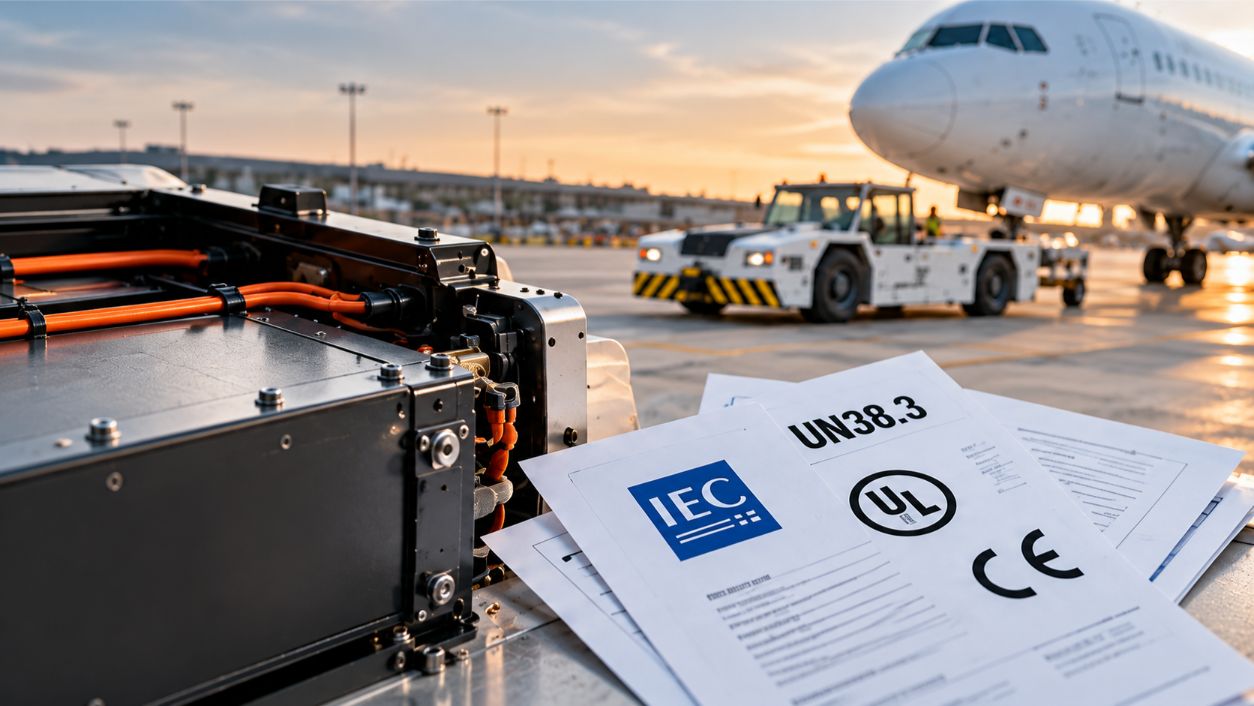
Battery certification should begin long before a battery reaches the testing laboratory. For OEMs developing electric equipment or converting existing vehicles, understanding the applicable standards and approval requirements from the outset is essential to developing a safe, reliable and commercially viable battery system.
At Lithion, we identify the certification requirements for the intended application and target markets early in the development process, then design the battery pack around those requirements.
Rather than developing a battery and addressing compliance at the end, this approach helps reduce the risk of costly redesigns, unnecessary testing and delays, supporting a more efficient route from initial development through to production.
Different battery applications are subject to different safety and regulatory requirements. A battery designed for electric ground support equipment (GSE), for example, may have different operating conditions and certification requirements from one used in stationary energy storage or other industrial applications.
Before beginning the battery design, it's important to establish how and where the battery will be used.
Key considerations include:
These requirements help establish which standards and approvals apply before key design decisions are made.
For OEMs developing electric equipment ranges or converting existing vehicles, understanding these requirements early can also create opportunities to standardise battery designs across multiple applications, reducing engineering complexity and supporting more efficient fleet management.
Battery certification requirements depend on the battery's intended use, design and target market. Different standards address different aspects of battery safety, transportation and system performance.
Common examples include:
In the European Union, Regulation (EU) 2023/1542 also introduces requirements relating to battery sustainability, safety, conformity assessment, traceability and product information, with obligations being phased in over time.
Depending on the battery system and its connectivity, OEMs may also need to consider cybersecurity requirements, including the EU Cyber Resilience Act, where applicable.
Not every standard applies to every battery. Establishing the relevant requirements early helps ensure that the battery is designed for its intended application and markets, rather than requiring changes once testing begins.
Once the applicable standards and approval requirements have been identified, they become part of the battery pack's design specifications.
Rather than developing a battery and assessing compliance at the end, Lithion considers certification requirements when selecting cells, designing the mechanical enclosure, configuring the battery management system (BMS) and defining electrical protection and system interfaces.
This means the battery is engineered with its intended approval pathway in mind from the beginning.
Several design areas are particularly important:
Each of these decisions can influence how the battery performs during testing and whether it meets the applicable requirements.
By considering certification during the design process, rather than after it, OEMs can reduce the likelihood of modifications during testing, avoid unnecessary development costs and improve confidence in their route to market.
For OEMs manufacturing multiple equipment types, battery standardisation can offer significant commercial advantages.
Different vehicles may require variations in battery capacity, mounting arrangements, connectors or communication interfaces. However, this does not always mean every configuration needs to be developed and tested as an entirely separate battery system.
For example, an OEM may require two battery packs with identical cells, electrical characteristics, BMS and internal construction, but different connector locations to accommodate different vehicle layouts.
Depending on the applicable standards, the nature of the changes and the assessment of the testing laboratory or certification body, it may be possible to evaluate these configurations as variants within a common testing or certification programme.
Considering these requirements during the initial design phase can help OEMs:
Not every design variation will qualify for shared testing or certification. Changes to electrical connections, mechanical protection or other safety-related features may require additional evaluation.
However, designing battery families with certification requirements in mind from the outset can create opportunities to simplify the approval process and reduce the overall cost of developing multiple battery configurations.
Battery testing should be planned alongside development, not treated as a final step before production.
Once the applicable requirements are established, they can be used to guide component selection, mechanical design, electrical architecture and system integration.
Engaging with testing laboratories early can help determine which evaluations are required, what documentation must be prepared and whether different battery configurations can be assessed within a common programme.
Depending on the application and applicable standards, testing may assess:
Planning these evaluations early helps identify potential design issues before the battery reaches the final stages of development.
Although testing and certification remain essential to demonstrating compliance, designing around the relevant requirements from the outset can help reduce unexpected costs and delays.
Certification and compliance do not end when a battery enters production.
Changes to battery components, suppliers, software, connectors or mechanical construction may affect previous testing or certification assessments.
For OEMs using batteries across multiple equipment platforms, managing these changes is particularly important.
Maintaining appropriate technical documentation, production controls and design change procedures helps ensure that modifications are evaluated against the applicable requirements.
Considering these factors during initial battery development can also make future product updates easier to manage, reducing the risk of unexpected compliance issues.
For OEMs, battery certification should not be an obstacle encountered at the end of development. It should be a fundamental consideration from the beginning.
Lithion works with customers to establish the relevant certification and approval requirements for their equipment and target markets before developing the battery pack design.
By incorporating these requirements into battery architecture, component selection, BMS configuration and mechanical design, we help OEMs reduce the risk of certification-related redesigns, control development costs and bring equipment to market more efficiently.
This approach also supports battery standardisation across equipment platforms, helping manufacturers simplify integration and reduce unnecessary complexity as they expand their electric product ranges.
Whether developing new electric equipment or converting existing diesel-powered vehicles, our objective is to deliver battery solutions designed to meet the application's operational and regulatory requirements from day one.
Planning a new electric equipment platform or an existing vehicle conversion?
Contact Lithion to discuss how designing around certification requirements from the outset can support your electrification strategy.
