

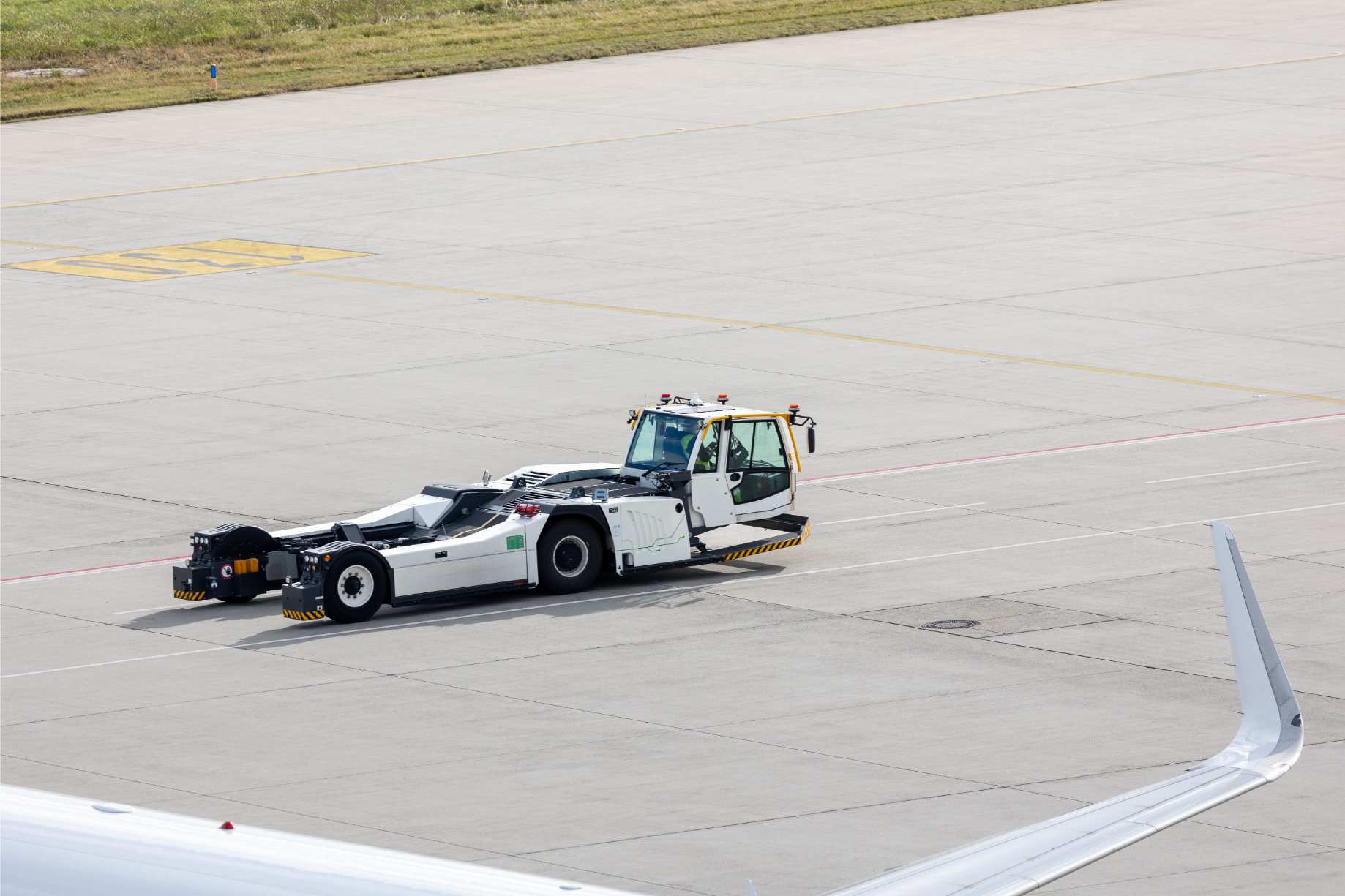
Ground support equipment operates in a demanding environment. Batteries can be exposed to intensive duty cycles, frequent charging, temperature extremes, vibration, moisture and debris, while the equipment itself needs to remain available throughout busy aircraft turnaround schedules.
Reliable operation therefore depends on more than simply choosing a battery with the right voltage and capacity.
The battery, Battery Management System (BMS), charger, vehicle controls and operating environment all need to work together as a system.
Selecting an appropriate battery solution from the outset, and understanding how that battery will actually be used can help reduce the risk of battery-related problems and unplanned GSE downtime.
Battery problems can develop for many reasons, ranging from incorrect specification and charging to environmental conditions and poor system integration.
Importantly, when GSE becomes unavailable, the battery itself isn't necessarily the cause.
A charging issue, communication fault, vehicle control problem, connector, motor controller or another component within the wider system can potentially result in equipment downtime.
This is why Lithion approaches GSE batteries as part of the wider vehicle and charging system rather than as an isolated component.
One of the most important steps in selecting a GSE battery is understanding how the equipment will actually be used.
Different types of GSE can have very different operating requirements.
An aircraft tug, for example, can require high levels of power during towing and pushback operations. A baggage tractor may experience repetitive operation throughout a shift, while a GPU can have a very different load profile again.
Important considerations can include:
Understanding these factors helps determine whether an existing off-the-shelf battery platform can meet the requirement or whether a custom battery system is more appropriate.
The objective shouldn't be to engineer a custom battery when an existing proven solution will do the job. Equally, a standard battery shouldn't be forced into an application where the duty cycle or integration requirements call for something different.
Charging is an important part of GSE battery reliability and fleet availability.
The battery and charger shouldn't be considered independently.
Charging voltage, current, communications and charging strategy need to be compatible with the battery system, while the operational charging strategy needs to reflect how the equipment is used.
This is particularly important for GSE because equipment may need to take advantage of relatively short charging opportunities between operations or during shift changes.
A battery capable of fast charging offers limited operational benefit if the available charger or site infrastructure cannot support the required charging rate.
Likewise, selecting a battery based purely on maximum capacity may not provide the most effective solution if the equipment has regular opportunities to recharge during the working day.
Considering the battery, charger and duty cycle together helps create an energy strategy around the actual operation rather than treating charging as an afterthought.
Electrical performance is only part of the requirement.
Airport GSE can be exposed to rain, dust, debris, fluids, temperature fluctuations, vibration and repeated mechanical movement.
Battery systems therefore need appropriate mechanical and environmental protection for the application.
Thermal performance is also important. Batteries have defined operating and charging temperature ranges, and operating outside those parameters can affect performance and battery life.
The appropriate solution will depend on the GSE application and operating location. Equipment operating through Scandinavian winters, for example, can present very different environmental challenges from GSE operating throughout summer in the Middle East.
Understanding the environment is therefore an important part of battery selection and system design.
A Battery Management System is an important part of a lithium-ion battery system.
Rather than simply measuring state of charge, an advanced BMS monitors and controls key aspects of battery operation.
Depending on the system, this can include monitoring cell voltage, current and temperature, managing contactors, balancing cells and providing protection against conditions such as over-voltage, under-voltage and temperature faults.
The BMS can also record operating events and communicate relevant battery information to the vehicle and other systems.
This creates several layers of protection and gives engineering teams greater visibility into what is happening inside the battery.
Monitoring and telemetry can add another layer to a GSE reliability strategy.
Information such as state of charge, state of health, voltage, current, temperature, charging activity and recorded events can help engineering teams understand how the battery is operating and investigate abnormal behaviour.
That information can be particularly valuable when diagnosing intermittent issues.
Rather than simply knowing that a vehicle stopped operating, engineers may be able to examine what was happening within the battery before and during the event.
Over time, data can also highlight differences in how equipment is being used.
One vehicle may be experiencing a more demanding duty cycle than comparable equipment. Another may consistently be charged differently. Equipment operating at a particular location may experience different environmental conditions.
These insights can help fleet teams investigate whether changes to charging, maintenance, equipment utilization or operating practices may be appropriate.
Monitoring cannot eliminate every possible failure, but greater visibility can make it easier to identify and investigate abnormal operating conditions before they result in more significant disruption.
A reliable battery solution doesn't automatically mean designing a completely new battery.
Lithion offers both proven off-the-shelf battery platforms and fully custom battery systems.
Where an existing battery meets the voltage, energy, power, environmental and integration requirements of the equipment, an off-the-shelf solution can provide a faster path to deployment.
Where the application has unique power, packaging, thermal, communication or environmental requirements, a custom battery may be the more appropriate approach.
This flexibility allows the battery strategy to follow the application rather than forcing every piece of GSE onto the same physical battery.
Lithion works with GSE OEMs and fleet operators to provide battery solutions for both new equipment and retrofit applications.
Our approach considers the complete battery system - including the battery pack, BMS, charging requirements, communications, equipment integration and operating environment.
Lithion's proprietary XB Battery Management System provides monitoring, protection, control, data logging and communications across our engineered battery systems. Depending on the system configuration, it can monitor state of charge, state of health, cell voltages, current and temperature while recording battery events and communicating with vehicle controls through protocols including CANBus, Ethernet, RS485, Modbus TCP and CANopen.
Our GSE battery systems can be engineered for demanding airside environments, including high-power applications, fast charging, vibration, temperature extremes and exposure to fluids and debris.
Combined with engineering and field application support, this gives customers a choice between proven off-the-shelf solutions and fully custom battery systems while maintaining a system-wide approach to integration and reliability.
Reliable electric GSE isn't created by one specification or component.
It comes from making sure the battery, BMS, charger, vehicle controls, operating environment and duty cycle work together.
That means asking the right questions at the beginning of an electrification project, selecting the appropriate battery architecture and maintaining visibility into how the system performs once the equipment enters service.
For operators, the objective is straightforward: GSE that is ready when the operation needs it.
For OEMs, it means having a battery partner that can take responsibility for the battery system and integration requirements, allowing their engineering teams to remain focused on building the equipment.
Lithion brings those requirements together with off-the-shelf and custom battery systems, proprietary BMS technology and engineering support designed around the demands of ground support equipment.