

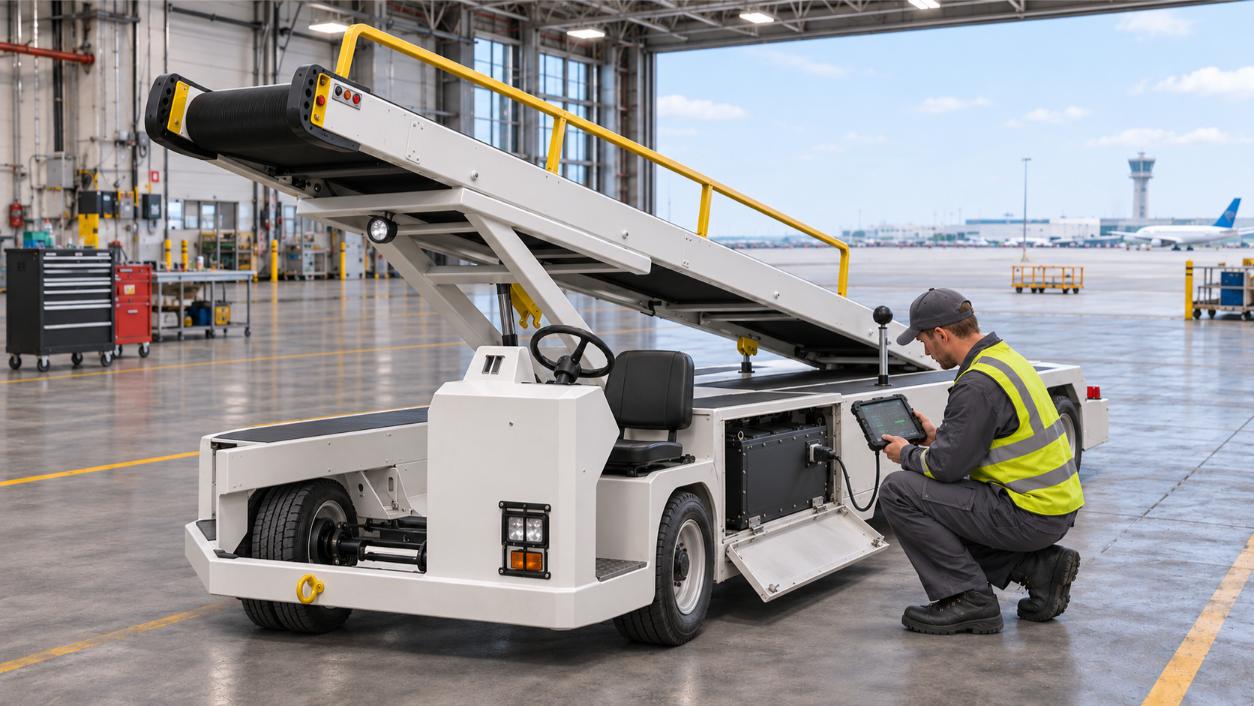
For airlines, ground handlers and ground support equipment (GSE) manufacturers, battery purchase price is only one part of the long-term cost of operating electric airport equipment.
Battery lifespan, energy consumption, charging infrastructure, maintenance requirements and operational reliability can all influence the total cost of ownership (TCO) of a GSE battery system.
A lower initial purchase price does not necessarily result in the lowest overall cost. Equally, a higher-priced battery does not automatically deliver better long-term value.
The most appropriate solution depends on the equipment's duty cycle, charging strategy, operating environment and expected service life.
Understanding these factors helps GSE operators and OEMs compare battery solutions on a consistent basis and make more informed investment decisions.
Total cost of ownership considers the costs associated with purchasing, integrating, operating, maintaining and eventually replacing a battery system over a defined period.
For GSE applications, this extends beyond the initial battery price to include energy consumption, charging requirements, servicing and the potential financial impact of battery-related downtime.
The main cost categories include:
Not every cost will apply equally to every operation. For example, an airport with suitable existing charging infrastructure may have a different cost profile from one requiring substantial electrical upgrades.
It is also important to distinguish battery-specific costs from wider vehicle and fleet operating costs, particularly when comparing different electrification strategies.
Several factors can influence the long-term cost of a GSE battery system.
The initial investment includes the battery itself and any additional work required to integrate it into the equipment.
For new electric GSE, battery integration may already form part of the OEM's vehicle design. For replacement batteries or conversion projects, additional costs may arise from mounting arrangements, electrical interfaces, charging compatibility or vehicle modifications.
Comparing battery purchase prices alone can therefore be misleading if the systems have different integration requirements.
Battery lifespan is an important consideration because replacement costs can represent a significant proportion of long-term ownership expenditure.
Lithium battery performance changes over time due to both calendar ageing and cycling.
The rate of degradation depends on several factors, including:
A battery's expected cycle life should not be considered independently of the application.
For example, two GSE fleets using similar battery systems may experience different battery lifespans because of differences in operating hours, charging behaviour and environmental conditions.
OEMs and operators should evaluate expected battery life against the actual duty cycle and the manufacturer's stated operating limits.
Electricity costs are another component of battery TCO.
The amount of electricity purchased to operate a battery-powered vehicle depends on the energy required by the equipment, charging efficiency and the way the battery is used.
Charging losses mean that the electricity drawn from the grid will generally be greater than the energy delivered to the battery.
Electricity tariffs, demand charges where applicable, and the timing of charging can also influence operating costs.
For airport operators managing multiple vehicles, charging schedules and infrastructure utilisation may have a meaningful effect on total fleet expenditure.
Maintenance requirements vary depending on battery technology, system design, operating conditions and manufacturer recommendations.
Lithium battery systems generally avoid some of the routine maintenance activities associated with flooded lead-acid batteries, such as electrolyte watering and equalisation charging.
However, lithium batteries still require appropriate inspection, monitoring, diagnostics and servicing.
Battery monitoring and telemetry can provide information about operating conditions, state of charge, temperature and system faults, depending on the capabilities of the battery system.
Access to relevant battery data can help operators identify potential issues and plan maintenance activities, although the financial benefit depends on how effectively that information is used.
For ground support equipment, operational availability is particularly important.
A battery fault or charging problem can make equipment unavailable when it is required for aircraft turnaround operations.
The financial consequences depend on the equipment type, fleet redundancy, operational schedule and the availability of replacement equipment.
For example, an unavailable baggage tractor may be easier to substitute where spare equipment is available, while the loss of a specialised vehicle could create greater operational disruption.
Battery reliability, service responsiveness, spare parts availability and warranty arrangements should therefore be considered alongside the initial purchase price.
However, downtime costs should be estimated using the operator's actual circumstances rather than assuming a fixed financial impact for every battery failure.
GSE equipment operates across a wide range of duty cycles, from intermittently used baggage tractors and belt loaders to equipment supporting more intensive airport operations.
These differences influence battery sizing, charging requirements and long-term ownership costs.
Selecting a battery with sufficient usable energy is essential to support the required operating period.
However, specifying more capacity than the application requires can increase initial cost, weight and installation demands without necessarily delivering a corresponding operational benefit.
Conversely, an undersized battery may require more frequent charging, restrict equipment availability or operate outside the intended duty-cycle assumptions.
Battery sizing should therefore consider energy consumption, peak power demands, available charging windows and operational reserves.
Opportunity charging allows equipment to recharge during scheduled breaks or periods of inactivity.
For some GSE applications, this may reduce the battery capacity required to complete daily operations.
However, the benefits depend on charger availability, charging power, battery acceptance limits and the time available between operating periods.
More frequent charging is not automatically beneficial or harmful to battery lifespan. Its effect depends on the battery chemistry, charging conditions and operating strategy.
Charging infrastructure is another important consideration, particularly where operators manage mixed fleets from different OEMs.
Differences in battery voltage, charging connectors, communication requirements and charging profiles can affect charger compatibility.
Where practical, greater standardisation across battery and charging systems may simplify infrastructure planning, maintenance and operator training.
However, compatibility must be verified at system level rather than assumed because two batteries operate at similar nominal voltages.
A meaningful TCO comparison should evaluate battery solutions over the same period and against the same operational requirements.
For example, an operator might compare two battery options over an eight-year evaluation period, using consistent assumptions for annual operating hours, energy consumption, electricity pricing and maintenance.
A simplified calculation can be expressed as:
Battery-related TCO = Initial investment + Charging and energy costs + Maintenance and repairs + Battery replacements + End-of-life costs − Residual or recoverable value
Where relevant, the wider fleet assessment can also include the estimated financial impact of battery-related equipment downtime.
Operators should use realistic assumptions supported by equipment duty-cycle data, battery specifications, warranty conditions and expected service requirements.
Where uncertainty exists, comparing multiple scenarios can help illustrate how changes in electricity prices, battery lifespan or utilisation affect the result.
It is also important to avoid double-counting costs, particularly where charging infrastructure, servicing or downtime expenses are already included in broader fleet operating budgets.
Airport fleets often contain multiple types of equipment, including baggage tractors, belt loaders, pushback tractors and other specialist vehicles.
Each application may have different energy, power and voltage requirements, making it impractical to use a single battery configuration across every vehicle.
However, standardisation can still offer potential advantages where equipment requirements are compatible.
Using common battery platforms, interfaces or charging arrangements may help operators:
The objective should not be to force every GSE application onto the same battery platform, but to identify opportunities to reduce unnecessary complexity without compromising equipment performance or operational requirements.
Battery warranty arrangements can influence the financial risk associated with long-term ownership.
However, warranty duration alone does not determine the value of the coverage.
Operators should understand the conditions of the warranty, including:
Long-term technical support, replacement parts availability and access to diagnostics are also important considerations.
A battery with a longer warranty may offer advantages, but the practical value depends on the coverage provided and the support arrangements available throughout the equipment's service life.
Lithion Solutions supports ground support equipment OEMs and operators with standard lithium battery platforms and custom-engineered battery systems.
Our approach starts with understanding the application, including equipment duty cycles, energy consumption, peak power requirements, charging strategy and operating environment.
Selecting the appropriate battery capacity, electrical configuration and integration approach can help avoid unnecessary system complexity and support more predictable long-term operating costs.
Lithion's capabilities include battery system engineering, in-house Battery Management System (BMS) technology, high-voltage system expertise and application integration support.
With US manufacturing capabilities and engineering support across Europe and North America, Lithion supports customers from initial battery selection through integration and production.
We also recognise the importance of battery monitoring, service requirements and long-term support when evaluating the operational and financial performance of electric GSE fleets.
The right battery solution starts with your application.
Contact Lithion to discuss your GSE battery requirements and explore how battery selection, charging strategy and system integration can support your long-term operational objectives.
