

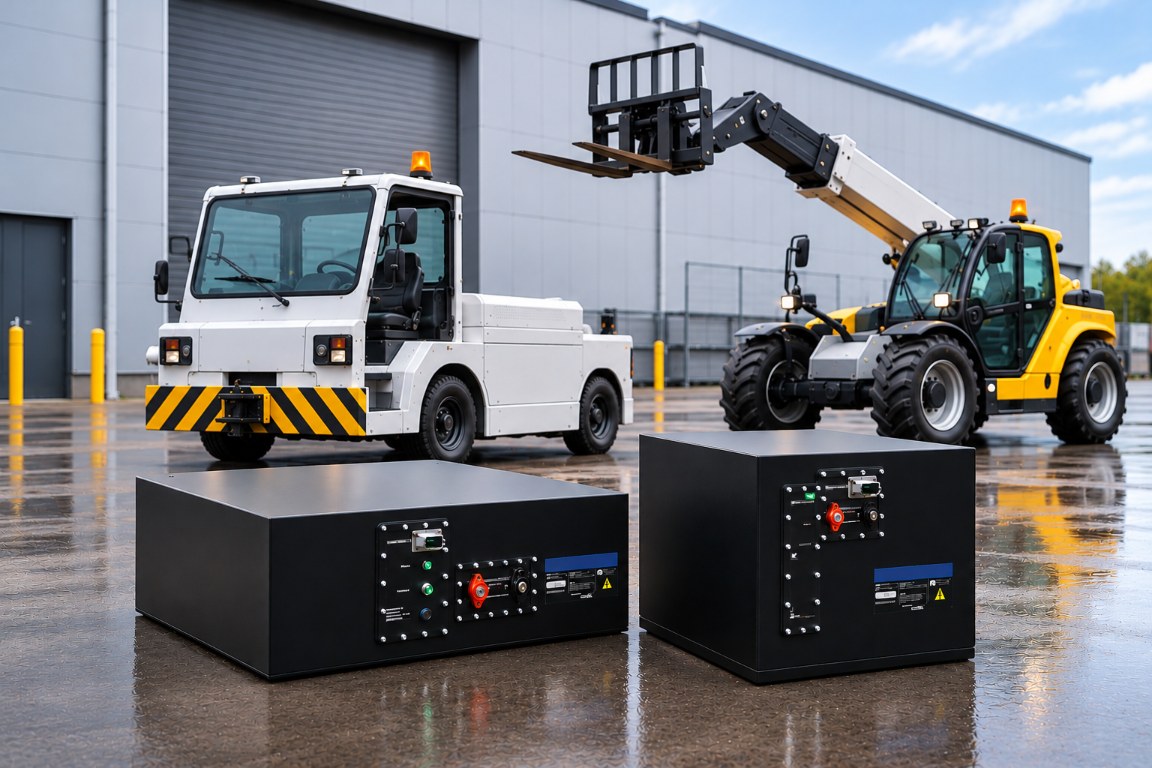
Off-highway OEMs face different battery requirements depending on the equipment, operating conditions and intended duty cycle. A compact excavator, agricultural tractor or wheel loader may have significantly different energy, power, packaging and charging requirements, even where the vehicles operate within a similar voltage range.
Selecting the right battery involves more than identifying the required capacity. OEMs must consider continuous and peak power demands, available installation space, thermal management, electrical integration, charging strategy and the operating environment.
Standard battery platforms can offer advantages in development time, cost and production readiness, particularly where existing products meet the application's technical requirements. However, some applications require modifications to an existing platform or a fully custom-engineered battery system.
The decision is therefore not simply whether a custom battery can be developed, but whether the technical and commercial benefits justify moving beyond an established standard platform.
This article examines the key considerations that help off-highway OEMs determine when a standard battery is sufficient, when modifications may be appropriate and when a bespoke design makes sense.
Off-highway equipment covers a broad range of applications, from compact construction machinery and agricultural vehicles to mining and industrial equipment.
Each application places different demands on its battery system, particularly in terms of operating hours, power requirements, charging opportunities and environmental conditions.
For example, a compact excavator may experience repeated power peaks associated with hydraulic operation, while an agricultural tractor may have varying energy demands depending on traction, power take-off (PTO) and auxiliary equipment.
Even within the same equipment category, battery requirements can differ significantly depending on the vehicle's size, duty cycle and intended use.
Key considerations include:
Understanding these requirements is the starting point for determining whether a standard or custom battery solution is appropriate.
OEMs do not necessarily need to choose between an entirely standard battery and a completely new custom design.
Depending on the application, there are three possible approaches.
Where an existing battery meets the application's energy, power, voltage, mechanical and environmental requirements, it may offer the most practical route to electrification.
Standard platforms can reduce the need for new battery development and may benefit from established manufacturing processes and existing product-level validation.
However, OEMs must still assess vehicle-level integration, testing and applicable compliance requirements.
Some applications may be supported through modifications to an existing battery platform.
Depending on the product architecture, this could involve approved changes to mounting arrangements, external interfaces or other configurable features.
This approach may offer a balance between application-specific requirements and the benefits of an established design.
However, modifications must be assessed carefully, as changes to an existing product can introduce additional engineering, testing or certification requirements.
A fully custom battery may be appropriate where existing platforms cannot meet essential technical requirements or where a dedicated design offers a justified commercial advantage.
Custom development can provide greater flexibility over battery packaging, electrical architecture, thermal management, control systems and integration.
The trade-off is typically additional engineering investment, development time, validation and manufacturing preparation.
Where custom development is required, the design can address a range of application-specific requirements.
The extent of customisation should be driven by the application rather than the assumption that a bespoke solution is inherently better.
For some OEMs, modifying an existing platform may achieve the required outcome with less development work than a completely new design.
Technical requirements are only one part of the decision.
OEMs must also consider development cost, production volumes, programme timing and long-term supply requirements.
Standard battery platforms can be attractive for lower-volume programmes because they may reduce non-recurring engineering costs and the amount of new product development required.
For higher-volume applications, custom development may become more commercially attractive where changes to packaging, integration or system design provide meaningful benefits over the programme lifetime.
However, higher production volumes do not automatically justify a custom battery, and lower-volume applications may still require bespoke engineering where standard products cannot meet essential requirements.
The decision should be based on the total programme cost rather than the battery purchase price alone.
Using an established battery platform may reduce development time, particularly where the product already meets the required electrical, mechanical and environmental specifications.
Custom development can involve additional design reviews, prototypes, testing, validation and production preparation.
OEMs should therefore assess whether the benefits of a custom solution justify any additional programme time and engineering investment.
For OEMs moving from prototype development to serial production, manufacturing capability is an important consideration.
Battery suppliers need to support consistent product quality, production scheduling, design change management and long-term component availability.
A custom battery programme may also require dedicated tooling, manufacturing processes or additional qualification activities.
These factors should be considered early in the selection process, particularly where the equipment will remain in production or service for many years.
The decision between standard and custom battery solutions becomes clearer when considered against specific applications.
Compact excavators often have limited installation space and variable power demands associated with hydraulic functions and machine movement.
Battery selection must account for the required operating hours, peak power demands, available space, weight distribution and charging opportunities.
Where an existing battery platform meets these requirements, it may reduce development costs and simplify the integration process.
However, where the available installation space or mechanical arrangement cannot accommodate a standard battery, an adapted or fully custom design may be appropriate.
Electric agricultural tractors can experience significant variation in power demand depending on the application.
Traction, power take-off (PTO) equipment, hydraulics and auxiliary systems can all influence battery sizing.
Operating schedules may range from shorter intermittent tasks to longer periods of continuous operation.
A standard battery platform may be suitable where the required energy, power and voltage can be accommodated within the available space.
Custom development may be justified where specific packaging, electrical integration, thermal management or operating requirements cannot be met by existing products.
Wheel loaders and similar construction machines may experience repeated high-power demands during loading, lifting and vehicle movement.
The battery must support these loads while meeting the equipment's energy requirements, charging strategy and environmental conditions.
Where a standard battery provides sufficient energy and power, it may offer a practical solution.
Where the application requires unique mounting arrangements, different electrical characteristics or application-specific thermal management, custom engineering may provide a better fit.
These examples are illustrative. Actual battery selection depends on the equipment's measured or modelled duty cycle and integration requirements.
Whether an OEM selects a standard, adapted or fully custom battery, successful integration requires more than matching voltage and capacity.
The battery must operate as part of the wider vehicle system, including the powertrain, charging equipment, control architecture and safety functions.
The Battery Management System (BMS) plays an important role in monitoring battery operation, managing protection functions and communicating relevant information to the vehicle.
Thermal management must also be considered, particularly where equipment operates across demanding temperatures or experiences repeated high-power charging and discharging.
Environmental conditions such as vibration, shock, dust and moisture exposure can influence battery design, installation and validation requirements.
Addressing these considerations early helps OEMs identify potential integration challenges and establish a clearer path towards production.
Lithion Solutions supports off-highway OEMs with standard lithium battery platforms and custom-engineered battery systems, helping manufacturers select the right solution for their application.
Our approach starts with understanding the equipment's operating requirements, including energy consumption, peak power, voltage, available installation space, charging strategy and environmental conditions.
Where a standard battery platform meets these requirements, it can help reduce development time, engineering cost and integration complexity.
Where application-specific requirements demand a different approach, Lithion can support custom battery system development and integration.
Our capabilities include battery system engineering, in-house BMS technology, high-voltage system expertise and application integration support.
Combined with US manufacturing capabilities and engineering support across Europe and North America, Lithion can support OEM programmes from initial battery selection through validation and serial production.
The right battery solution starts with your application.
Contact Lithion to discuss your off-highway battery requirements and explore whether a standard, adapted or custom battery solution is the most appropriate fit.
