


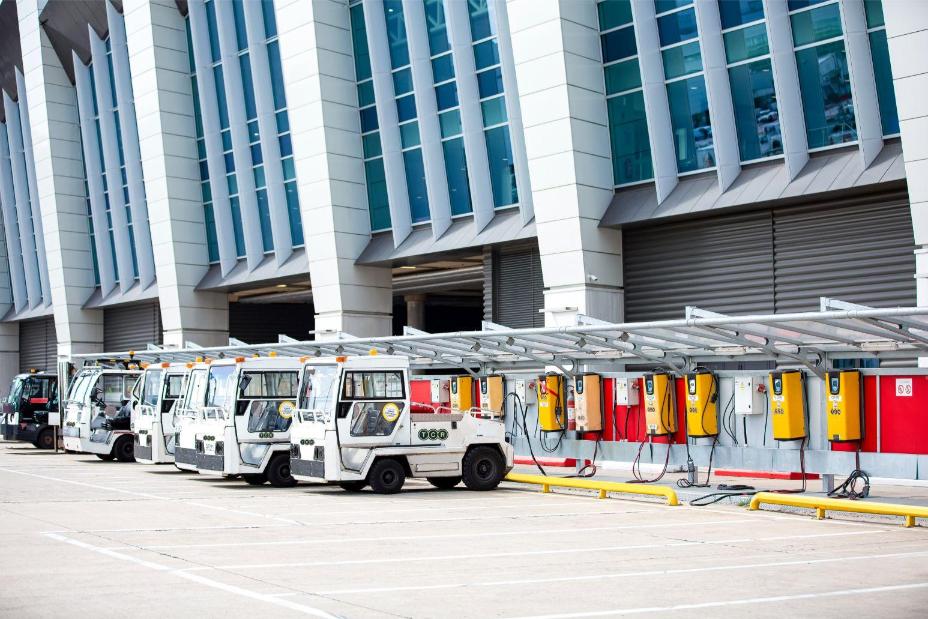
Electrifying ground support equipment (GSE) involves more than replacing diesel engines with batteries. Operators also need to consider how equipment will be charged, where charging infrastructure is located and how charging schedules fit around daily airport operations.
A well-planned GSE battery charging strategy can help reduce downtime, improve fleet availability and avoid unnecessary investment in batteries and charging infrastructure.
For operators managing different types of GSE, the challenge becomes more complex. Vehicles may use different battery voltages, charging connectors and communication systems, making it difficult to standardise charging across a fleet.
Understanding how battery capacity, duty cycles and opportunity charging work together is essential to developing an efficient electrification strategy.
Unlike many industrial applications, airport ground support equipment operates around aircraft schedules, with limited flexibility for unplanned downtime.
Baggage tractors, belt loaders, pushback tractors and cargo loaders can have very different operating profiles, even when working at the same airport.
Some vehicles operate intermittently, with regular periods of inactivity, while others may be required continuously during busy operating periods.
A charging strategy needs to consider:
Without understanding these requirements, operators risk selecting batteries that are unnecessarily large or installing charging infrastructure that cannot support operational demand.
Opportunity charging involves recharging a battery during planned breaks or periods of inactivity, rather than relying exclusively on longer charging sessions between shifts.
For example, an electric baggage tractor may operate for several hours before returning to a parking area between aircraft movements.
If suitable charging infrastructure is available, the vehicle can replenish some of the energy consumed before returning to service.
This approach can reduce the amount of battery capacity required onboard, provided the available charging time and power are sufficient.
Consider a baggage tractor consuming 24 kWh during an operating shift.
Illustrative example only. Actual battery capacity must account for usable energy, reserve margins, charging losses, ageing and operational requirements.
In this example, opportunity charging reduces the amount of stored energy required at the beginning of the shift.
However, this approach only works if charging opportunities are predictable, sufficient charging power is available and the battery can safely accept the required charge.
For equipment with limited downtime or unpredictable schedules, a larger battery may still be the more practical solution.
An effective charging strategy starts with understanding how each vehicle operates and the energy it requires between charging opportunities.
For some vehicles, overnight or between-shift charging may be sufficient.
Others may benefit from opportunity charging throughout the day, particularly where equipment regularly returns to the same location.
In many cases, the most practical approach will involve a combination of both methods.
One of the challenges facing GSE operators is managing vehicles with different battery and charging requirements.
A mixed fleet may include equipment operating at 48 V, 80 V, 100 V, 400 V or other system voltages, depending on the application and vehicle manufacturer.
Charging compatibility involves more than matching voltage.
Operators and OEMs also need to consider:
Two batteries with similar nominal voltages may not necessarily be compatible with the same charger.
This can create additional costs when operators need different charging equipment for different vehicles, particularly as fleets expand or equipment is replaced.
Considering battery and charger compatibility early in the electrification process can help reduce infrastructure complexity and create opportunities for greater fleet standardisation.
For OEMs developing new electric GSE, selecting a battery architecture that supports clearly defined charging interfaces can also simplify integration and long-term support.
Charging power determines how quickly energy can be replenished, but the charger's rated output does not always represent the power delivered throughout a charging session.
For example, a charger delivering 20 kW for 30 minutes could theoretically supply 10 kWh of energy.
However, the actual energy stored in the battery will depend on charging efficiency, battery temperature, state of charge and the charging limits imposed by the BMS.
Higher charging power may reduce downtime, but it also increases demands on electrical infrastructure and potentially on battery thermal management.
For airports managing large electric GSE fleets, simultaneous charging is another important consideration.
If 20 vehicles each require 20 kW of charging power at the same time, the combined charger output could reach 400 kW, before accounting for charging losses and other site electrical loads.
Operators therefore need to consider not only individual charger specifications but also the total electrical demand of the fleet.
Load management and scheduled charging can help distribute demand, potentially reducing peak electrical requirements without compromising vehicle availability.
Battery chemistry, cell selection and thermal management all influence charging performance.
Lithium iron phosphate (LFP) batteries are commonly used in industrial applications because of their cycle life, thermal stability and suitability for repeated charging.
However, charging capability varies between battery designs, even when they use the same chemistry.
Important considerations include:
For example, charging lithium-ion batteries at low temperatures can require reduced charging current or battery preheating to avoid damage.
At high temperatures, the BMS may also limit charging power to protect the battery.
These factors become particularly important when opportunity charging relies on short, predictable charging windows.
A battery that cannot accept the required charging power under actual operating conditions may not recover sufficient energy before returning to service.
As airports transition towards electric GSE, charging infrastructure can become a significant part of the overall investment.
Different battery voltages, connector types and communication requirements can result in multiple charger configurations across the same fleet.
While complete standardisation may not be practical for every application, operators can benefit from evaluating opportunities to simplify their battery and charging requirements.
This could include:
A more coordinated approach can reduce unnecessary equipment duplication, simplify maintenance and improve flexibility as electric fleets expand.
An effective GSE charging strategy needs to balance battery capacity, charging performance, equipment availability and infrastructure costs.
At Lithion, we work with OEMs and GSE operators to understand the operational and technical requirements of their equipment before recommending a battery solution.
Our off-the-shelf and custom lithium-ion battery systems, supported by our own BMS technology, allow us to address battery capacity, charging requirements and integration considerations as part of the overall system design.
By considering battery selection and charging compatibility together, we help customers identify opportunities to simplify electrification, improve equipment availability and reduce total cost of ownership.
The objective isn't simply to charge batteries faster. It's to ensure the right energy is available when equipment needs it, without unnecessary battery or infrastructure costs.