


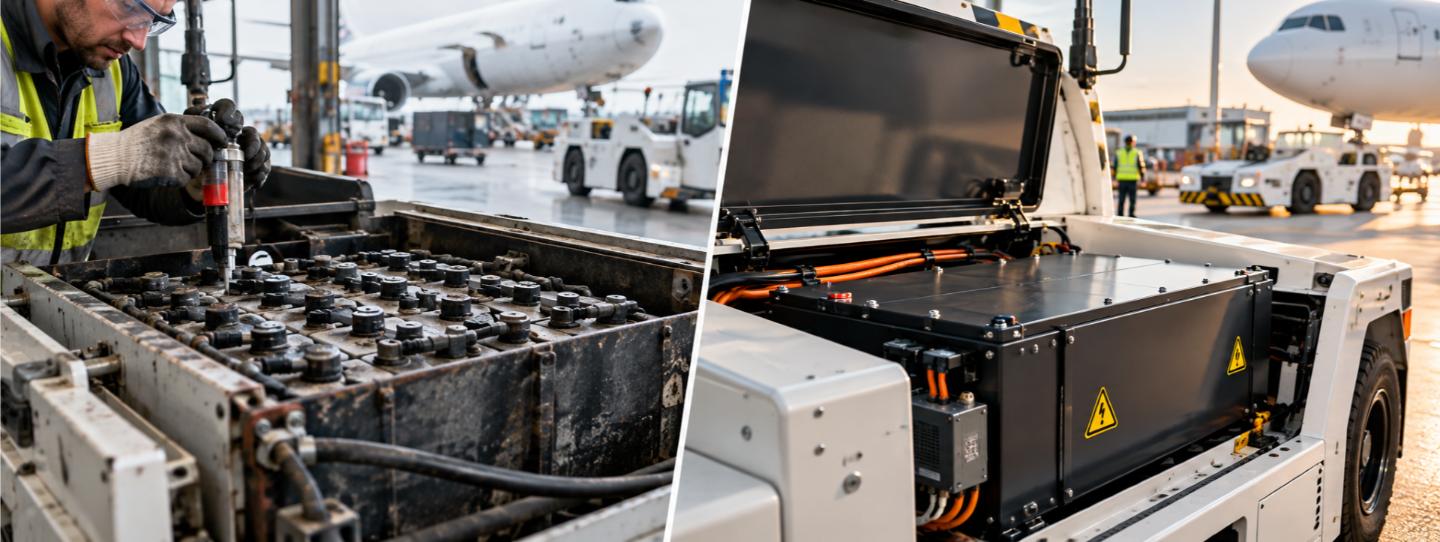
Choosing the right battery technology for ground support equipment (GSE) can have a significant impact on operating costs, vehicle availability and long-term fleet performance.
While lead-acid batteries have been widely used in electric GSE for decades, lithium iron phosphate (LFP) technology is increasingly being adopted for new equipment and battery replacement programmes.
Both technologies can power electric baggage tractors, belt loaders, aircraft tugs and other GSE, but their differences in charging performance, usable energy, maintenance and battery life can affect the overall cost and efficiency of airport operations.
For OEMs and fleet operators evaluating GSE battery solutions, understanding these differences is essential when selecting the most suitable technology.
LFP and lead-acid batteries differ in several important areas, including energy density, charging performance, cycle life and maintenance requirements.
These are general comparisons. Actual performance depends on battery design, chemistry, operating conditions and charging strategy. Maintenance requirements also vary between flooded and sealed lead-acid batteries.
Airport ground support equipment operates around demanding aircraft schedules, where reliability and equipment availability are essential.
Vehicles may operate across multiple shifts, experience frequent starts and stops, and have limited opportunities for extended charging periods.
For these applications, LFP technology offers several potential advantages.
One of the most significant differences between LFP and lead-acid technology is charging performance.
LFP batteries can be designed to accept higher charging currents, allowing equipment to recover energy more quickly during available downtime.
This makes opportunity charging particularly relevant for GSE operating across multiple shifts.
For example, a baggage tractor may have short periods of inactivity between aircraft movements. With a suitable LFP battery and compatible charger, some of the energy consumed can be replenished before the next operation.
Lead-acid batteries generally require longer charging periods, particularly during the final stages of charging, making frequent short charging sessions less effective.
For operators, this difference can influence equipment availability, charging infrastructure and the number of vehicles required to support daily operations.
Battery cycle life is another important consideration when comparing LFP and lead-acid technologies.
LFP batteries typically support significantly more charge and discharge cycles than conventional lead-acid batteries when operated within their specified limits.
This can reduce the frequency of battery replacements, particularly for equipment operating multiple shifts or requiring frequent charging.
However, battery life depends on more than chemistry alone.
Depth of discharge, charging rates, operating temperature and battery management all influence long-term performance.
The most suitable battery should therefore be selected around the actual operating profile rather than cycle life claims alone.
Traditional flooded lead-acid batteries require regular maintenance, including electrolyte checks, watering, cleaning and inspection.
These activities create additional labour requirements and can take equipment out of service.
LFP batteries eliminate routine electrolyte watering and generally require less battery-level maintenance.
However, lithium-ion systems still require appropriate inspection, monitoring and servicing in accordance with the manufacturer's requirements.
For large GSE fleets, reducing routine battery maintenance can help lower operating costs and improve equipment availability.
LFP batteries typically offer higher energy density than lead-acid batteries, allowing more energy to be stored within a smaller or lighter battery system.
They can also generally operate across a wider usable state-of-charge range without the same impact on battery life associated with repeatedly deep-discharging lead-acid batteries.
This means a lithium-ion battery with a lower nominal kWh rating may, in some applications, provide similar usable energy to a larger lead-acid battery.
However, the comparison must account for the battery's actual operating limits, efficiency and required reserve capacity.
Replacing lead-acid batteries with LFP technology is not always a straightforward battery swap.
Although both technologies may operate at similar nominal system voltages, their electrical characteristics, charging requirements and physical properties are different.
Several factors need to be assessed before converting existing GSE.
Lead-acid and LFP batteries have different voltage characteristics, even when described using the same nominal voltage.
For example, an existing 80 V lead-acid vehicle may require an LFP battery configuration specifically designed to operate within the vehicle's acceptable voltage range.
The battery must also support the equipment's continuous and peak power requirements.
Existing lead-acid chargers may not be suitable for LFP batteries without modification or replacement.
Compatibility depends on charging voltage, current limits, charging profiles, connectors, safety interlocks and communication requirements.
Some chargers can support multiple battery chemistries or be reconfigured, but this must be validated before use.
For operators managing mixed fleets, selecting batteries that work with existing or standardised charging infrastructure can help reduce conversion costs.
One important consideration is the difference in weight between lead-acid and LFP batteries.
Lead-acid batteries are significantly heavier, and some GSE vehicles rely on this weight for counterbalance, traction or stability.
Replacing a heavy lead-acid battery with a lighter LFP battery may therefore require additional ballast or changes to the battery enclosure.
Any conversion must maintain the vehicle manufacturer's weight distribution, axle loading and stability requirements.
LFP batteries require a Battery Management System (BMS) to monitor and protect the battery.
The BMS manages functions such as cell voltage monitoring, temperature protection, current limits and charging control.
Depending on the equipment, integration may also require communication with the vehicle controller, charger or other electrical systems.
Addressing these requirements early can help avoid compatibility issues and reduce installation complexity.
Although LFP batteries typically cost more to purchase than lead-acid alternatives, the initial battery price does not reflect the full cost of ownership.
Fleet operators should consider the costs incurred throughout the battery's operating life.
For example, an operator replacing lead-acid batteries several times over the service life of a vehicle may find that a higher initial investment in LFP delivers a lower overall cost.
However, the financial benefit depends on equipment utilisation, battery replacement intervals, electricity costs, maintenance requirements and any investment needed in charging infrastructure.
The most relevant comparison is therefore not simply the purchase price of LFP versus lead-acid, but the total cost of operating the equipment over its expected service life.
LFP offers clear advantages for many GSE applications, but it is not automatically the best solution for every vehicle.
Equipment with low utilisation, limited charging requirements or an existing lead-acid system approaching the end of the vehicle's service life may not justify the additional investment in conversion.
For higher-utilisation equipment, particularly vehicles operating multiple shifts, the benefits of faster charging, reduced maintenance and longer battery life can be more significant.
OEMs and operators should assess:
Evaluating these factors helps determine whether LFP provides a meaningful operational and financial advantage.
At Lithion, we work with GSE OEMs and fleet operators to develop battery solutions around real-world equipment requirements.
Our off-the-shelf and custom LFP battery systems, supported by our own BMS technology, allow us to address battery capacity, power requirements, charging compatibility and vehicle integration as part of the overall system design.
Whether developing new electric GSE or evaluating the replacement of existing lead-acid batteries, we help customers identify solutions that balance performance, reliability, integration requirements and total cost of ownership.
For GSE operators, the value of LFP goes beyond replacing one battery chemistry with another. It's about reducing operating costs, improving equipment availability and making electrification more practical across the fleet.