


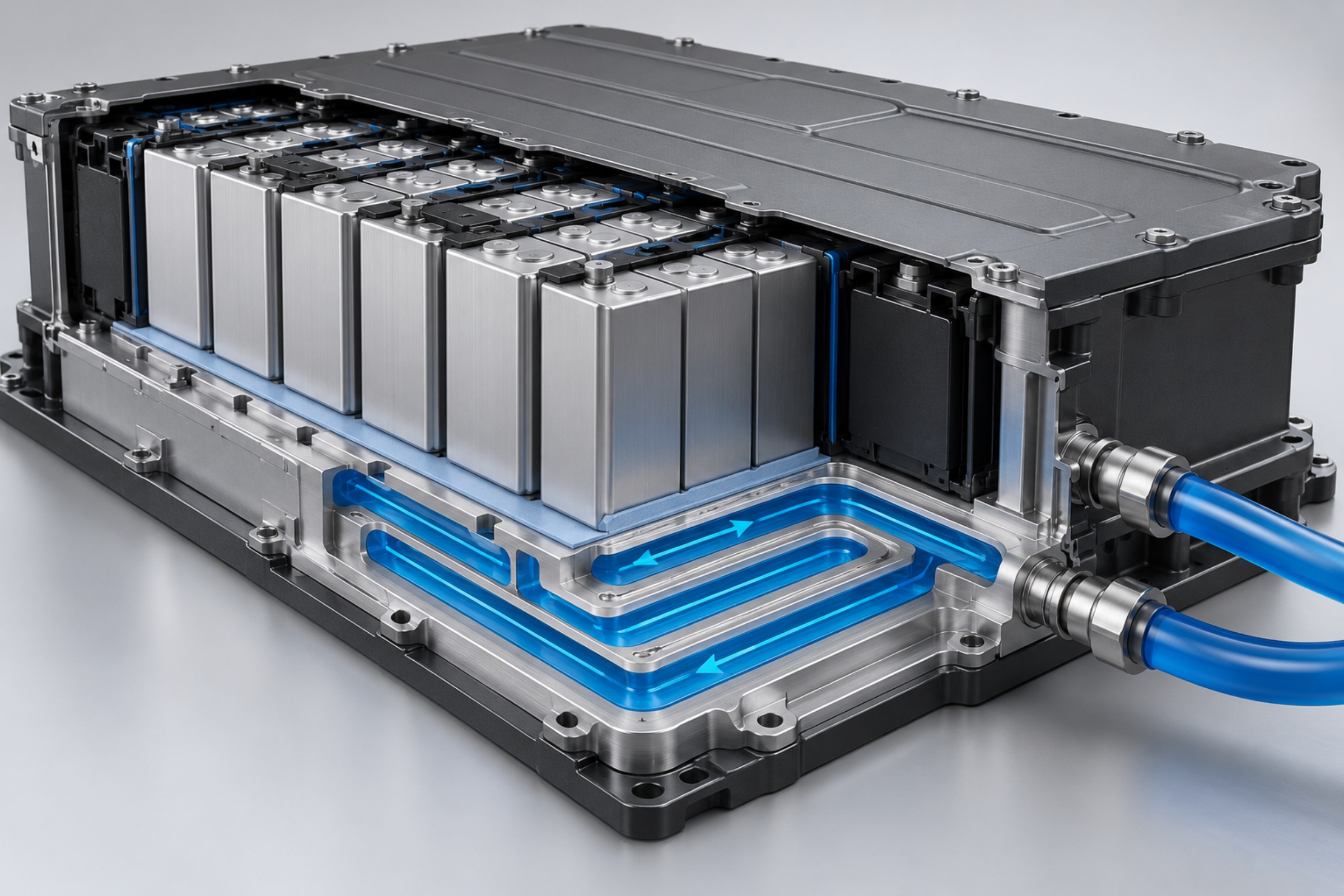
Whether an OEM is selecting an off-the-shelf (OTS) battery or developing a custom battery system, thermal performance needs to be considered as part of the complete application.
Lithium-ion cells generate heat during charging and discharge, and the amount of heat produced can vary considerably depending on power demand, current, charging rate, cell characteristics, duty cycle and operating conditions.
Temperature can influence battery performance, charging capability, efficiency, degradation and overall system reliability.
For OEMs, the objective isn't simply to keep a battery cool.
It is to ensure that the cells and other temperature-sensitive components remain within their intended operating conditions throughout the equipment's real duty cycle.
That requires the battery, thermal system, BMS, charging strategy, equipment and operating environment to be considered together.
Lithium-ion cells are designed to operate within defined temperature limits.
Operating conditions outside the appropriate range can affect battery behaviour.
At elevated temperatures, degradation can accelerate and additional demands can be placed on cells and battery components.
At low temperatures, available power and charging capability can be affected, and charging may need to be restricted or controlled according to cell requirements.
But average battery temperature isn't the only consideration.
Engineers also need to understand how temperature is distributed throughout the battery.
Significant differences between cells or modules can mean different parts of the battery are operating under different thermal conditions.
Effective thermal design therefore considers both:
Overall battery temperature + Temperature uniformity across the system
The appropriate approach depends on the application.
There isn't one thermal management strategy that works for every lithium-ion battery.
The requirements are influenced by the complete application, including:
A battery operating at moderate power in a temperature-controlled environment may require a relatively straightforward thermal approach.
A battery experiencing repeated high-power loads, rapid charging or extreme ambient temperatures can present a very different engineering challenge.
This is why battery thermal requirements should be based on how the equipment actually operates, rather than voltage or energy capacity alone.
Choosing an off-the-shelf battery can provide significant advantages.
The battery architecture has already been developed, and its thermal characteristics and operating limits can be established as part of the existing platform.
However, this doesn't automatically make an OTS battery suitable for every application.
The OEM still needs to establish whether the battery is appropriate for:
For example, an OTS battery that performs well in one application may experience very different thermal conditions if installed in an enclosed compartment with restricted airflow or used with a significantly more demanding duty cycle.
Selecting an OTS battery therefore isn't simply a question of matching voltage and kWh.
Its power, thermal, charging, environmental and integration characteristics also need to match the application.
Where an existing battery platform meets the application requirements, it can provide an effective route to electrification without unnecessary custom development.
In other cases, an existing battery architecture may provide the right starting point but require customization.
And where the thermal, power, packaging or environmental requirements cannot be effectively met by an existing platform, a fully custom battery system may be appropriate.
Custom thermal engineering can become particularly relevant where applications involve:
The objective shouldn't be to introduce a complex thermal management system unless the application requires it.
It should be to select the simplest effective thermal strategy capable of meeting the operating requirements of the battery and equipment.
Thermal management can take different forms depending on the application.
These aren't necessarily interchangeable solutions.
The appropriate approach depends on the battery and application.
Thermal systems can also incorporate features such as temperature sensors, thermal interface materials, insulation, cooling plates or channels and BMS control strategies.
The goal isn't necessarily to maintain one exact battery temperature.
It is to keep the system within appropriate operating limits and manage temperature distribution throughout the battery.
Thermal design begins earlier than choosing a cooling method.
Cell selection itself can influence the thermal behaviour of the battery.
Different cells can have different:
A cell that is appropriate for a relatively low-power energy application may not be the right choice for equipment experiencing frequent high-power loads.
The same applies to module configuration.
How cells are arranged physically and electrically can influence current distribution, heat generation and the ability to transfer heat away from the cells.
This is why thermal management shouldn't be viewed as a separate system added after the electrical architecture has been designed.
Cell + Module + Thermal System need to be engineered together.
Battery thermal performance is sometimes associated primarily with high-voltage systems, but voltage alone doesn't determine thermal demand.
For a given power requirement:
Power = Voltage × Current
Higher-voltage architectures can reduce the current required to deliver a given level of power.
Lower-voltage systems delivering substantial power may therefore experience very high current, creating their own thermal and electrical design challenges.
At the same time, a high-voltage battery operating at substantial continuous power or accepting high charging power can also require sophisticated thermal management.
The relevant question isn't:
“Is this a high-voltage battery?”
It is:
“What electrical and thermal loads will this battery experience in the real application?”
Charging can be one of the most important thermal considerations in a battery application.
Higher charging rates can increase thermal loads, while cell temperature can also affect the charging rate the battery can safely accept.
This creates a relationship between:
Battery → BMS → Thermal System → Charger → Charging Strategy
For OEMs, the fastest possible charge isn't necessarily the optimal solution.
The appropriate charging strategy depends on factors including:
Where rapid or opportunity charging forms part of the equipment's operating model, thermal behaviour during charging needs to be considered early in battery selection and system design.
The Battery Management System provides visibility of temperature conditions within the battery and can form part of the system's thermal protection and control strategy.
Depending on the battery architecture, BMS functionality can include:
This doesn't mean the BMS itself solves every thermal challenge.
The physical battery still needs an appropriate thermal design.
Instead, the BMS provides the monitoring and control needed to help the battery operate within its defined parameters.
Lithion's proprietary BMS technology can support battery monitoring, protection, control, data logging and communications as part of the wider battery system.
A battery's thermal requirements should be evaluated against representative operating conditions.
Average power alone may hide important thermal events.
Equipment might experience:
These patterns can produce very different thermal behaviour.
Where real operational data is available, it can provide valuable input when selecting an OTS battery, customizing an existing platform or developing a fully custom battery system.
The closer the thermal assessment reflects the real duty cycle, the more useful it becomes.
Whether an OEM chooses an OTS battery, a customized existing platform or a fully custom battery system, the thermal characteristics need to be appropriate for the intended application.
For an established OTS platform, this can involve confirming that the existing battery's validated operating envelope matches the new application and verifying relevant aspects of integration.
Where an existing battery is customized, engineers need to assess whether those changes affect its thermal behaviour or existing validation.
For a fully custom system, thermal testing forms part of the wider battery development and validation program.
Depending on the application, testing can evaluate:
Thermal testing shouldn't be an isolated exercise.
Electrical performance, charging, physical design, BMS functionality and thermal behaviour all interact.
The objective is to understand how the complete battery system behaves under representative operating conditions.
Lithion can approach OEM battery requirements through different development routes.
The appropriate choice depends on the equipment.
A custom battery isn't automatically better than an OTS battery, and an OTS battery isn't automatically simpler once it is installed in a demanding application.
The important question is whether the complete battery system is suitable for the job it needs to perform.
Lithion supports OEMs with off-the-shelf, customized and fully custom lithium-ion battery systems for industrial and mobility applications.
The starting point is understanding the application:
Power + Energy + Duty Cycle + Charging + Environment + Packaging + Integration
From there, our engineers can assess whether an existing battery platform meets the requirement, whether a proven architecture can be customized, or whether the application requires a fully custom system.
Thermal requirements are considered alongside the complete battery architecture, including:
Cells + Modules + BMS + Thermal Management + Charger + Communications + Equipment Integration
Lithion's proprietary BMS technology provides monitoring, protection, control, data logging and communications capabilities that can form part of the wider thermal and battery management strategy.
For custom development, Lithion can support OEMs from initial requirements and feasibility through system engineering, prototyping, validation, integration and production.
For OTS solutions, the focus is on matching an established battery platform to the requirements of the equipment and supporting successful system integration.
Thermal management isn't simply about adding cooling to a battery.
It begins with understanding the cells, power requirements, duty cycle, charging strategy, installation and operating environment.
Sometimes the right answer is an existing battery platform with an established thermal design.
Sometimes an existing architecture needs to be adapted.
And sometimes the application requires a completely custom battery and thermal system.
The principle remains the same:
Understand the duty cycle.
Understand the thermal load.
Select the right battery architecture.
Manage temperature appropriately.
Validate it against the application.
Whether the final solution is off-the-shelf or custom, the objective is to ensure the battery's thermal performance matches the equipment it is there to power.