


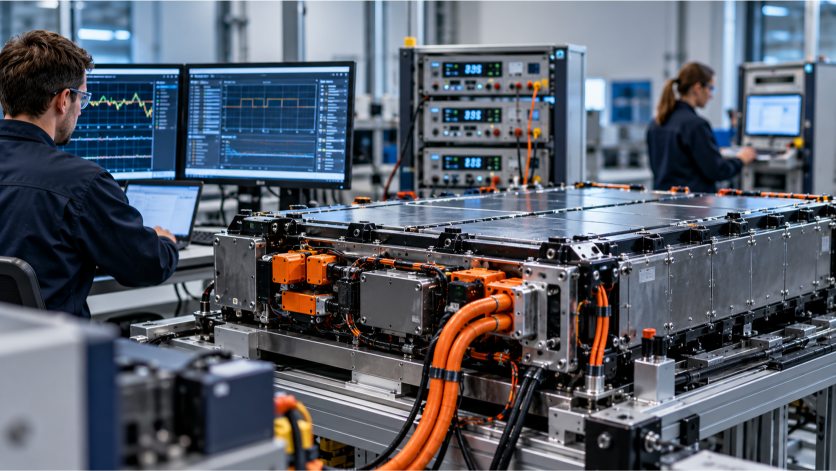
Battery safety and functional safety are essential considerations when developing electric equipment. Battery safety focuses on preventing or mitigating electrical, thermal and mechanical hazards, while functional safety ensures that safety-related control functions respond correctly when potentially dangerous conditions occur.
For original equipment manufacturers (OEMs), both should be considered from the beginning of battery development. Understanding the relevant safety requirements early helps guide battery architecture, cell selection, battery management system (BMS) configuration and integration with the wider equipment.
At Lithion, we consider these requirements from the outset, helping OEMs develop battery solutions designed for their intended applications while reducing the risk of costly redesigns, integration challenges and development delays.
Battery safety and functional safety are closely connected, but they address different aspects of equipment safety.
Battery safety focuses on reducing hazards associated with the battery itself. This includes selecting suitable cells, managing temperature, providing electrical insulation and protecting internal components against vibration, impact and environmental exposure.
Functional safety focuses on ensuring that safety-related control functions operate correctly when required, including during specified fault conditions. In a battery system, these functions may include detecting unsafe voltage or temperature conditions and initiating appropriate protective actions.
For example, a battery enclosure may provide physical protection against mechanical damage, while the BMS may detect an unsafe operating condition and initiate a defined response.
Both are important to the overall safety of electric equipment.
While a BMS may include protective functions, this does not automatically mean it meets a particular functional safety standard. The applicable requirements depend on the equipment, the risks involved and the intended application.
A battery pack does not operate independently of the equipment it powers. Its protection functions must work alongside the charger, motor controller and wider vehicle or machine control systems.
For OEMs developing new electric equipment or converting existing diesel-powered vehicles, understanding these interactions is an important part of the design process.
A structured safety assessment should consider:
For example, an immediate battery shutdown may be appropriate in some applications. In others, such as a moving industrial vehicle, an uncontrolled loss of power could introduce additional risks.
The appropriate response depends on the equipment's risk assessment and how the complete system is designed to reach or maintain a safe condition.
Defining these requirements early helps OEMs and battery manufacturers establish clear interfaces and responsibilities, reducing the risk of integration issues later in development.
At Lithion, battery safety requirements are considered from the beginning of the design process rather than addressed only when testing begins.
Once the application, operating environment and relevant standards have been established, these requirements help guide the battery's design and integration.
Important considerations include:
By incorporating these requirements into the initial battery architecture, OEMs can reduce the likelihood of costly design changes and improve confidence in the battery's suitability for its intended application.
This approach is particularly relevant when developing battery solutions for demanding industrial environments, where reliability, equipment availability and safety are closely connected.
Different battery applications are subject to different safety and functional safety requirements. The applicable standards depend on the battery's intended use, equipment type and target market.
Common standards and testing requirements include:
These standards address different aspects of safety and are not interchangeable. Not every standard applies to every battery or application.
For example, a battery used in industrial ground support equipment may have different safety and functional safety requirements from one used in a road vehicle.
Establishing which standards apply before beginning battery development helps ensure that the relevant requirements are considered when selecting components, designing protection systems and defining interfaces with the wider equipment.
Safety requirements must be supported by appropriate testing and validation.
Battery-level testing may assess electrical abuse, vibration, thermal behaviour, mechanical protection and other conditions defined by the applicable standards.
Where functional safety requirements apply, additional analysis and validation may be needed to demonstrate that defined safety functions perform correctly under specified operating and fault conditions.
This may include assessing:
Testing should be planned alongside development, allowing potential issues to be identified before the battery reaches the final stages of design.
Importantly, validating battery protection functions is not the same as validating the functional safety of the complete vehicle or machine.
The OEM and relevant system suppliers must establish how their respective components contribute to overall equipment safety and agree on the necessary integration and validation activities.
Battery safety and functional safety considerations continue beyond initial development and testing.
Changes to battery components, software, operating conditions or equipment interfaces may affect previously assessed safety functions.
For OEMs, this makes appropriate documentation, change management and ongoing validation important throughout the product lifecycle.
For example, a BMS software update or change to a battery component may require an assessment of whether existing safety assumptions and test results remain valid.
Working with a battery partner that understands these requirements can help OEMs manage changes more effectively and reduce the risk of unexpected integration or compliance issues.
For OEMs, battery safety and functional safety should be considered from the beginning of equipment development, not addressed after the battery and control systems have been selected.
Lithion works with customers to understand their equipment, operating environment and applicable safety requirements before developing the battery solution.
By considering these requirements when designing the battery pack, configuring the BMS and defining interfaces with the wider equipment, we help OEMs address potential safety risks early, reduce integration complexity and avoid costly changes during development.
Whether developing new electric equipment or converting existing vehicles, our approach is to deliver battery solutions designed around the application's safety, performance and operational requirements from the outset.
Developing new electric equipment or planning an existing vehicle conversion?
Contact Lithion to discuss your battery system requirements and how early consideration of safety can support your electrification strategy.